
Reviewed · GARNI, GEGHARD & SYMPHONY OF STONES DAY TRIPS
Private Tour to Garni Temple, Geghard Monastery, Echmiadzin Cathedral, Zvartnots
Four UNESCO stops in one long day. This private tour strings together Charents’ Arch, Garni Temple, Geghard Monastery, Echmiadzin Cathedral, Hripsime, Gayane, and Zvartnots into a practical, story-filled route out of Yerevan.
I love the pacing. You get real time on the big sites—about an hour at Garni, Geghard, and Etchmiadzin—so you’re not speed-walking through sacred places. I also love the optional guide upgrade: when you’re with someone like Arev, the day can blend history with everyday Armenia, while the driver David-style professionalism keeps the transfers smooth.
One thing to plan around: the tour price covers transport and guides (if you add one), but several entrances and lunch cost extra, including Garni Temple, Zvartnots, and the Echmiadzin Treasury Museum.
In This Review
- Key highlights to know before you go
- Why this Best of Armenia route works in one 7-hour day
- Charents’ Arch: the Ararat viewpoint before the temples
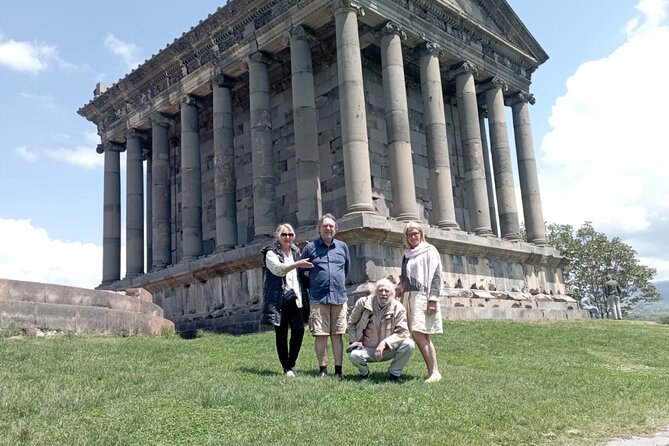
- Garni Temple: Armenia’s preserved pagan monument
- Geghard Monastery: a cave monastery with a living spring vibe
- Etchmiadzin Cathedral and the Treasury Museum decision
- Saint Hripsime and Saint Gayane: two churches, one sacred mood
- Zvartnots Temple ruins: how a 7th-century giant became a museum
- Price and what you’re really paying for
- Service, guide quality, and the pacing that makes it work
- Small practical tips for a comfortable full heritage day
- Should you book this private tour?
- FAQ
- How long is the private tour from Yerevan?
- What does the tour cost for a private group?
- Are hotel pickup and drop-off included?
- Is a guide included?
- What’s included in the price?
- What are the entrance fees that cost extra?
- Is lunch included?
- What languages is the tour available in?
- Can I cancel for a refund?
- What ticket type will I use?
Key highlights to know before you go
- One-vehicle, private route that hits multiple UNESCO heritage sites in a single day
- Charents’ Arch viewpoint for Ararat views before the churches and monasteries
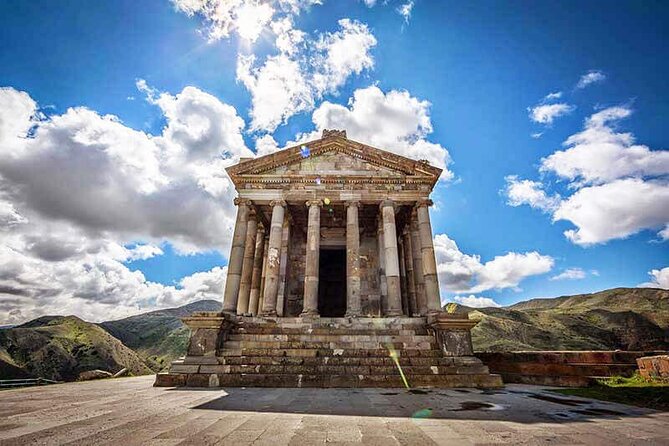
- Garni Temple: Armenia’s best-preserved pagan temple, tied to a larger sun-and-state story
- Geghard as a cave monastery: carved-in architecture with a strong sense of place
- Etchmiadzin and surrounding churches: cathedral, treasury artifacts, and cross-stones in one complex
- Zvartnots ruins and models: earthquake history plus museum-style reconstructions
Why this Best of Armenia route works in one 7-hour day
This is the kind of day trip I like when you only have a limited schedule in Yerevan. You cover a big chunk of Armenia’s heritage without the hassle of renting a car, hiring separate guides, or doing complicated transport math. And because it’s private, the flow is flexible enough to pause for photos and ask questions without feeling rushed.
The route also makes sense as a theme: you move from pagan Armenia (Garni) to early Christianity (Geghard and Etchmiadzin) and then into later church architecture (the Hripsime and Gayane churches). You end with Zvartnots, where the ruins still show how monumental the original temple was.
The total duration is about 7 hours, and that length is important. It’s long enough to feel like a full day, not just a quick drive-by, but not so long that you spend the whole day fighting fatigue. Just pack for a solid walking day: even “short” stops add up when you’re moving between courtyards and viewpoints.
More Garni and Geghard runs with the Symphony of Stones from Yerevan
- Group Tour: Garni, Symphony of Stones, Geghard, Lavash Baking
★ 5.0 · 1,042 reviews - Yerevan: Garni, Geghard, Symphony of Stones & Lavash Baking
★ 5.0 · 589 reviews - Group Tour: Garni pagan temple, Geghard monastery, Lake Sevan, Sevanavank
★ 5.0 · 430 reviews - Group Tour: Khor Virap, Garni temple, Geghard, Lavash baking
★ 5.0 · 333 reviews
Charents’ Arch: the Ararat viewpoint before the temples
You start at Charents’ Arch, near Yerevan, between Garni and Geghard. The funny part is that from a distance it looks ordinary—until you move inside the arch platform and the wider panorama clicks into place. This is one of the most direct ways to frame Armenia’s “great and sacred” mountain view.
You’ll spend about 30 minutes here, and admission is listed as free. That makes it a low-cost, high-reward opener. It also helps you get your bearings before the heavier religious sites—your brain has a breather before the caves and cathedrals.
Practical note: this viewpoint can be a photo magnet, so bring your patience. If you’re visiting in clear weather, take your time inside the arch first, then step back for wider shots once you’ve got your angle.
Garni Temple: Armenia’s preserved pagan monument
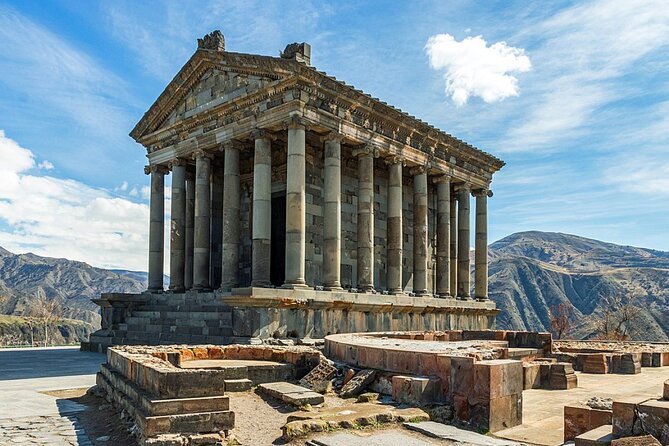
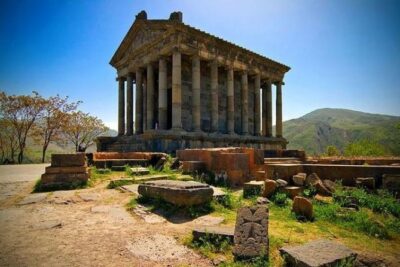
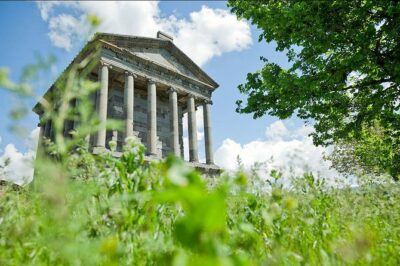
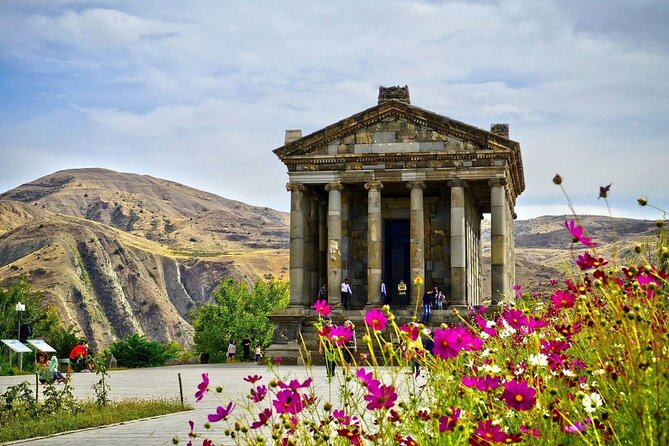
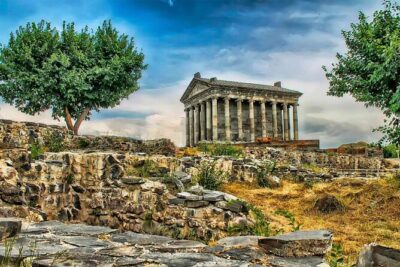
Next comes Garni Temple, the only pagan temple preserved on Armenian territory. It was built in the second half of the 1st century by King Trdat III, and after Christianity became official, the complex shifted in use—serving as a summer residence connected to Khosrovadukht, Trdat III’s sister.
The structure you see today carries the scars of the past. The tour notes that Garni was destroyed by an earthquake in 1679, and what’s left includes temple fragments and stones scattered around the site. The temple is also linked in the materials to Mithra, the sun god, which gives the place an extra layer beyond “old stones.”
You’ll have about 1 hour at Garni. Entrance is not included, so you’ll pay on-site. There’s usually a choice at this stop too: the tour mentions extra entrance fees connected with Garni Temple and the nearby Symphony of the Stones, so decide before you arrive what you want to prioritize.
How to enjoy this stop more: think of it as a “conversion story in architecture.” Even if you’re not religious, the site shows how power and belief show up in public buildings. And if the sun is out, the temple’s geometry reads even better.
Geghard Monastery: a cave monastery with a living spring vibe
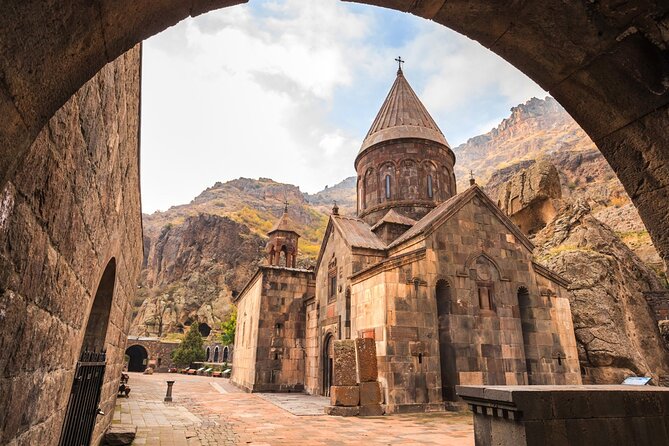
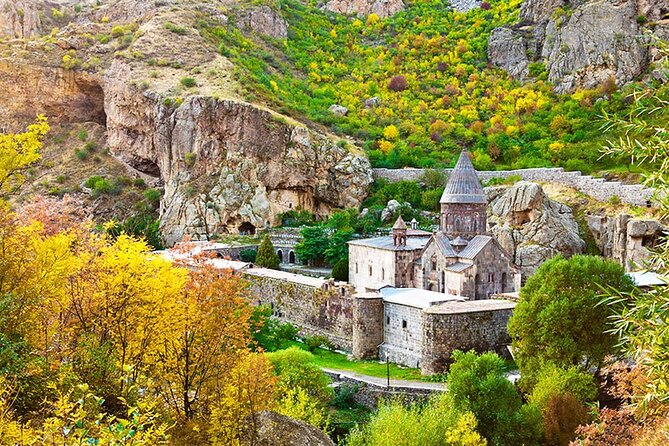
Then you head to Geghard Monastery, one of the great medieval architectural complexes in Armenia. The defining feature is that it’s hollowed out in a cave, so you experience a temple space that feels carved from the rock rather than built on top of it.
Geghard is described as being founded in the 4th century AD at the place of a sacred spring originating in the cave. The name Geghard (spear) ties to the spear of Longinus mentioned as piercing Jesus on the cross, with the spear noted as being kept in Etchmiadzin.
You get about 1 hour, and admission is listed as free. That matters because it’s one of those UNESCO-quality stops you don’t have to “budget” entrance fees for. It also means you can spend time looking at details: stone surfaces, doorways, and how the space compresses and then opens.
Cave tip: caves can feel cooler even in warm months. If you tend to run hot, bring a thin layer anyway. You’ll also want comfortable shoes. The routes inside and around can be uneven, and you’re spending time in a historic complex—not on polished museum floors.
More Echmiadzin and Zvartnots cathedral tours from Yerevan
Etchmiadzin Cathedral and the Treasury Museum decision
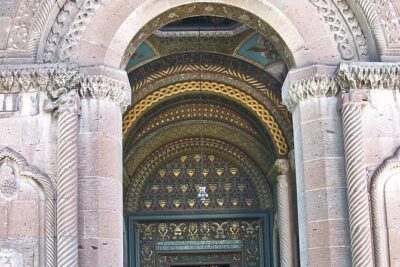
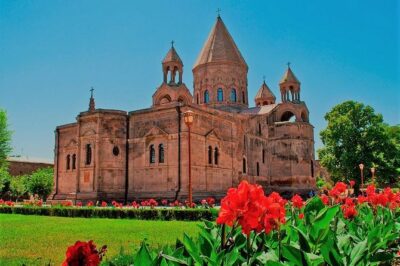
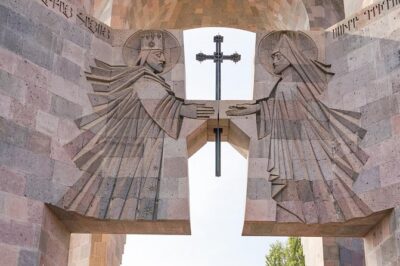
Etchmiadzin is where the day becomes intensely Armenian in a way you can feel. The tour focuses on the Etchmiadzin Monastery complex and its Cathedral. The name is described as meaning place of the descent of the Only Begotten, and there’s a specific detail that stands out: besides the main altar in the eastern part, there is another altar in the middle at the site of the descent of Christ.
This stop also includes the Treasury Museum area, where the tour lists relics and ceremonial items—church clothes embroidered with gold and pearls, catholicos’ staffs and crosses, and ritual objects made of gold, silver, and ivory. Entrance to that Treasury Museum is not included, so you’ll choose whether to pay.
You’ll spend about 1 hour at Etchmiadzin, with admission to the main complex listed as free. The surrounding buildings also include the residence of the Armenian patriarch, the Catholicos of all Armenians, which adds a sense that this isn’t only a historical site. It’s a place tied to ongoing religious life.
Two cross-stones are specifically called out: Amenaprakich from 1279, and a cross-stone devoted to the victims of the 1915 genocide. If that topic is emotional for you, plan a slower moment here instead of trying to power through photos. A quiet minute can be more meaningful than a dozen snapshots.
Saint Hripsime and Saint Gayane: two churches, one sacred mood
After Etchmiadzin, you visit two nearby churches inside the broader religious setting: Saint Hripsime Church and Saint Gayane Church.
Saint Hripsime: founded in the 7th century by Catholicos Komitas I Aghtsetsi on the place of Saint Hripsime’s sepulcher. It’s also mentioned as included in UNESCO World Heritage since 2000. You’ll have about 30 minutes, and admission is free. The courtyard includes burial of two Catholicoses: Astvatsatur (1715–1725) and Garaped II Oolnetzi (1725–1729).
Saint Gayane: built in the 7th century in honor of St. Gayane, on the site of a 4th century chapel. The tour points out that relics of St. Gayane are kept in the southern wall near the altar niche. It also notes that 17th century murals survive above the western entrance, tied to the birth of Christ. You get another 30 minutes, and admission is free.
The material also mentions a room near Saint Gayane connected to the older rite called matah, involving animals sacrificed and stabbed for occasions like weddings or births. That’s part of the site’s description, so if you’re sensitive to religious rites, it may help to ask your guide where your comfort line is and focus on architecture and art where you can.
What I like about stacking these two churches back-to-back: you see how Armenian Christian architecture repeats themes while still offering different details—mural remnants here, burial history there, and different sacred focal points.
Zvartnots Temple ruins: how a 7th-century giant became a museum
To close the day, you visit Zvartnots Temple, the “Temple of Vigil Forces,” built in the 7th century. The temple was built for 20 years, and the tragic part is that it was destroyed by a powerful earthquake in the 20th century, leaving ruins behind.
Even as ruins, it’s treated as a major site. Today Zvartnots is an archaeological reserve and museum founded in 1937. You’ll see model versions of reconstruction and numerous sculptural fragments, including impressive large-size pieces. Entrance is listed as not included, so you’ll pay for admission to the reserve/museum portion.
You get about 1 hour here. It’s a good amount of time because it’s not just walking: you’ll be reading and visually comparing. The models can help you understand scale—without them, ruins can look like random piles. With them, your brain can rebuild the temple quickly.
Practical angle: ruins can be exposed. If it’s sunny or windy, plan for that. The earlier shade at caves and courtyards gives you a break, but Zvartnots may feel more open and airy.
Price and what you’re really paying for
The price is $105 per group (up to 3 people), for about 7 hours. On paper that’s a “tour cost,” but in value terms, you’re buying three things that add up fast when you DIY: private transport with a professional driver, hotel pickup and drop-off, and (if you choose it) an English or Russian-speaking guide.
Included in the tour:
- hotel pickup and drop-off
- bottled water
- air-conditioned vehicle
- WiFi on board
- private transportation
- guide service optional (English or Russian)
- professional driver
Not included:
- lunch
- entrance fee for the Echmiadzin Treasury Museum
- entrance fee for Zvartnots
- entrance fees for Garni Temple and Symphony of the Stones
So the smart way to think about cost is this: most of the core sacred sites are listed as free admissions (Geghard, Etchmiadzin complex, Saint Hripsime, Saint Gayane, and Charents’ Arch). The bigger paid entrances are Garni Temple, Zvartnots, and the Treasury Museum. Add lunch, and you have a clean, predictable budget.
One more practical detail: you get a mobile ticket and WiFi on board. That matters on a long drive day. You can plan photos, check maps, and avoid that awkward moment when your phone dies and suddenly you’re a cryptographer.
Service, guide quality, and the pacing that makes it work
This is private, so your day depends less on a big-group rhythm and more on the person guiding you. The optional guide upgrade is a big deal if you want context beyond what you can read on plaques.
In the feedback tied to this kind of tour experience, English-speaking guides are often praised for being friendly and for connecting history to modern Armenia. Names that came up include Arev, described as a friendly, informative guide for historical sights and modern Armenia. That kind of guidance turns each stop from an isolated photo opportunity into a chain of ideas.
Drivers also get credit in the same way. One driver name tied to positive experiences is David, with comments about smooth transfers and good overall day handling.
Pacing-wise, the itinerary’s structure helps: you’re not stuck at one site all day. You get a mix of longer blocks (around an hour) and shorter stops (30 minutes). That keeps your legs moving, but it also keeps attention fresh.
If you choose not to add a guide, you might still have the driver provide key point orientation. One account specifically mentions a private setup with no guide and only drivers, who still showed people around key points. That’s worth considering if you want lower cost and your interests are mainly architecture and quick context rather than deep explanations.
Small practical tips for a comfortable full heritage day
A few habits make this day easier.
First, plan for a long stretch of being “on.” Even when stops feel short, you’re entering courtyards and walking between them. Comfortable shoes are not optional.
Second, dress in layers. You’ll go from viewpoints that can feel exposed to cave interiors and churches where temperatures can shift.
Third, plan your lunch around the Garni area. Lunch isn’t included, but the day includes time where Garni is in the mix, and that’s a practical place to eat before you move on to Geghard and Etchmiadzin.
Finally, use the free stops as breathing room. Charents’ Arch is free and short. Saint Hripsime and Saint Gayane are free and short. Those are built-in chances to slow down, not just rush.
Should you book this private tour?
Yes—if your goal is maximum heritage value from Yerevan in a single day. This route makes sense for people who want UNESCO sites with minimal logistics stress: you get private pickup/drop-off, an air-conditioned car, bottled water, and optional guide support.
Book it if:
- you want a private group day with room for questions
- you care about Armenian religious and architectural evolution from pagan to Christian sites
- you’d rather pay one organized day instead of juggling multiple transfers
Think twice if:
- you dislike paying extra on-site for major entrances like Garni Temple and Zvartnots
- you want a fully included meal plan (lunch isn’t included)
- you want a slow, museum-heavy day rather than a multi-stop loop
If you’re short on time but still want the big hits, this one-day Best of Armenia plan is a solid use of your hours.
FAQ
How long is the private tour from Yerevan?
It’s about 7 hours (approx.), covering all the stops in one full-day outing.
What does the tour cost for a private group?
The price is $105 per group, up to 3 people.
Are hotel pickup and drop-off included?
Yes. Pickup and drop-off from your hotel, apartment, or hostel are included.
Is a guide included?
Guide service is optional. The tour can include an English or Russian-speaking guide service if you choose the upgrade.
What’s included in the price?
Included items are hotel pickup and drop-off, bottled water, an air-conditioned vehicle, WiFi on board, optional guide service, and a professional driver with private transportation.
What are the entrance fees that cost extra?
Entrance fees are not included for the Echmiadzin Treasury Museum, Zvartnots Temple, Garni Temple, and the Symphony of the Stones. Charents’ Arch and several other stops listed are free.
Is lunch included?
No. Lunch is not included.
What languages is the tour available in?
English is offered, and the optional guide upgrade can be English or Russian.
Can I cancel for a refund?
Yes. There is free cancellation up to 24 hours in advance of the experience start time for a full refund.
What ticket type will I use?
You’ll receive a mobile ticket.
More Tour Reviews in Yerevan
- Group Tour: Garni, Symphony of Stones, Geghard, Lavash Baking★ 5.0 · 1,042 reviews
- Group Tour: Lake Sevan (Sevanavank), Dilijan (Goshavank, Haghartsin)★ 5.0 · 1,036 reviews
- Group tour: Khor Virap, Noravank, Areni Winery and Cave★ 5.0 · 651 reviews
- Yerevan: Garni, Geghard, Symphony of Stones & Lavash Baking★ 5.0 · 589 reviews
- Group Tour: Tsaghkadzor (Kecharis, Ropeway), Lake Sevan, Trout barbecue treat★ 5.0 · 511 reviews
More Echmiadzin & Zvartnots Cathedral Tours
- Group Tour: Echmiadzin Cathedral & churches, Zvartnots Temple★ 5.0 · 352 reviews
- Private Half-day Echmiadzin Cathedral, Hripsime & Zvartnots Temple from Yerevan★ 5.0 · 95 reviews
- Private tour to Echmiadzin (st Cathedral), Zvartnots, Khor Virap, Garni, Geghard★ 5.0 · 67 reviews
- Private 8-9-hour Echmiadzin, Zvartnots, Garni and Geghard trip from Yerevan★ 5.0 · 62 reviews
- Khor Virap, Echmiadzin & Zvartnots UNESCO Small-Group Guided Tour★ 5.0 · 40 reviews
More Garni, Geghard & Symphony of Stones Trips
- Group Tour: Garni, Symphony of Stones, Geghard, Lavash Baking★ 5.0 · 1,042 reviews
- Yerevan: Garni, Geghard, Symphony of Stones & Lavash Baking★ 5.0 · 589 reviews
- Group Tour: Garni pagan temple, Geghard monastery, Lake Sevan, Sevanavank★ 5.0 · 430 reviews
- Group Tour: Khor Virap, Garni temple, Geghard, Lavash baking★ 5.0 · 333 reviews
- Private 7-8-hour Khor Virap, Garni temple & Geghard monastery trip from Yerevan★ 5.0 · 272 reviews
Still deciding? Here are more Yerevan tours and Armenia day trips we have written up






Garni, Geghard & Symphony of Stones Day Trips, compared.
 ★ 5.0Group Tour: Garni, Symphony of Stones, Geghard, Lavash BakingFrom $281,042 reviews
 ★ 5.0Garni, Geghard, Symphony of Stones & Lavash BakingFrom $23589 reviews
 ★ 5.0Group Tour: Garni pagan temple, Geghard monastery, Lake Sevan, SevanavankFrom $41430 reviews
 ★ 5.0Group Tour: Khor Virap, Garni temple, Geghard, Lavash bakingFrom $38333 reviews
 ★ 5.0Private 7-8-hour Khor Virap, Garni temple & Geghard monastery trip from YerevanFrom $120272 reviews
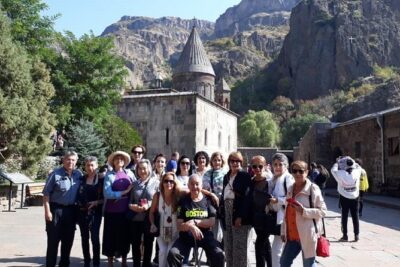 ★ 5.0Garni, Geghard & Symphony Small-Group Day Trip with Lavash BakingFrom $26263 reviews
 ★ 5.0Private Half-Day Garni Temple and Geghard Monastery Tour from YerevanFrom $89245 reviews
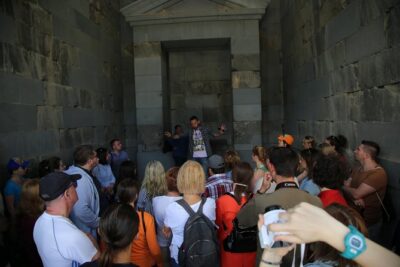 ★ 5.0Private 7-8 hour Trip to Garni – Geghard – Lake Sevan – Sevanavank from YerevanFrom $124185 reviews
Browse the lists this tour appears in